
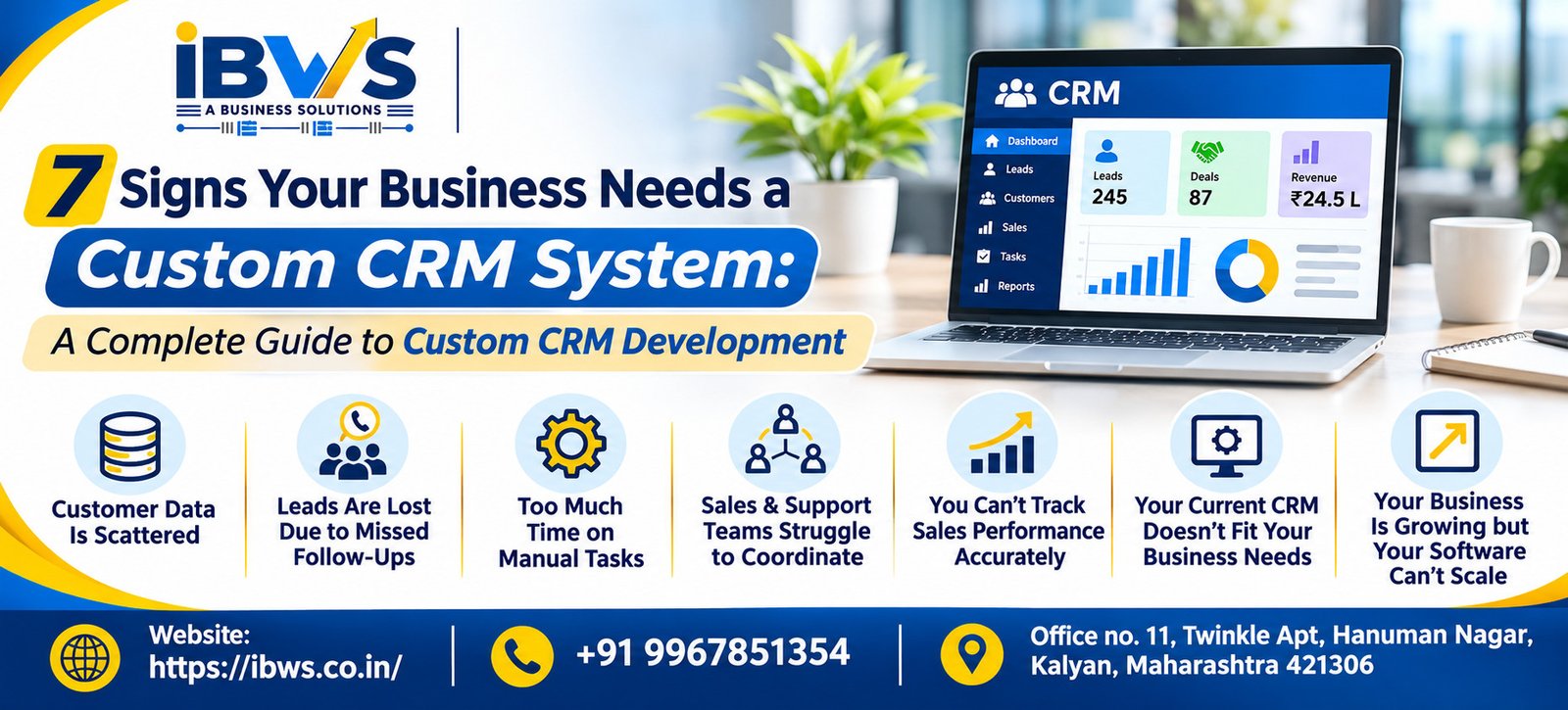
7 Signs Your Business Needs a Custom CRM System: A Complete Guide to Custom CRM Development – IBWS
Custom CRM Development is becoming essential for businesses that want to manage customer relationships, automate daily operations, and improve overall productivity. As businesses grow, handling customer data, tracking sales leads, and managing follow-ups through spreadsheets and manual processes can become increasingly challenging.
Investing in Custom CRM Development allows businesses to create a personalized Customer Relationship Management system that matches their specific requirements. Unlike ready-made CRM software, customized CRM solutions help streamline workflows, centralize customer information, improve team coordination, and simplify sales management.
At IBWS – A Business Solutions, businesses can explore Custom CRM Development and Business Software Services designed to support lead management, workflow automation, and efficient business operations. With the right CRM system, organizations can reduce repetitive tasks, improve customer communication, and support long-term business growth.
In this blog, we will explore the 7 signs your business needs a custom CRM system, the benefits of customized CRM software, and how Custom CRM Development can help improve business efficiency.
1. What Is Custom CRM Development?
Custom CRM Development is the process of designing, developing, and implementing Customer Relationship Management software according to the unique requirements of a business.
Unlike ready-made CRM platforms that provide predefined features and workflows, custom CRM software can be developed to match specific business operations, departmental responsibilities, customer journeys, and reporting requirements.
A customized CRM system may include lead management, customer databases, sales tracking, task assignments, follow-up reminders, automated notifications, employee management, and performance reporting.
For example, a real estate company may require a CRM that tracks property enquiries, site visits, customer preferences, and booking stages. A service-based business may need a CRM that manages customer complaints, technician assignments, service schedules, and payment records.
Custom CRM software allows businesses to organize these activities within a centralized platform.
However, developing a custom CRM also involves planning, investment, testing, maintenance, and ongoing technical support. Businesses should evaluate whether customization provides enough operational value compared with configuring an existing CRM product.
2. Sign 1: Your Customer Data Is Scattered Across Multiple Platforms
One of the clearest signs that your business may need custom CRM development is difficulty managing customer information.
Many companies store customer details in Excel sheets, Google Sheets, email inboxes, WhatsApp conversations, and separate departmental software.
When information is distributed across multiple platforms, employees may struggle to find accurate customer records.
For example, a sales executive may have customer contact details in one spreadsheet, quotation information in another file, and follow-up discussions in WhatsApp.
This creates unnecessary delays and increases the risk of duplicate records, missed communication, and inconsistent information.
How Custom CRM Development Helps
A custom CRM system can centralize customer information within one database.
Employees with appropriate permissions can access customer profiles, enquiry history, previous interactions, quotations, and relevant business records.
Centralized data management can improve coordination and reduce the time spent searching for information.
It also enables businesses to establish consistent data-entry practices and maintain more organized customer records.
3. Sign 2: Your Business Is Losing Leads Due to Missed Follow-Ups
Generating leads through websites, Google Ads, social media, and referrals is important. However, converting those leads into customers requires timely communication.
Many businesses lose potential opportunities because sales teams forget follow-ups or fail to track customer enquiries.
For example, a customer may enquire about a service through a website contact form. If the enquiry is not assigned to the appropriate employee or followed up promptly, the customer may approach another provider.
How Custom CRM Development Helps
A customized CRM can support automated lead capture, enquiry assignment, follow-up reminders, and lead status tracking.
Businesses can design workflows that match their sales processes.
For example, a new enquiry may automatically appear in the CRM dashboard and be assigned to a sales representative.
The system can then display pending follow-ups, scheduled meetings, quotations, and lead conversion stages.
With suitable integrations and configuration, custom CRM software can help reduce missed opportunities and improve response consistency.
4. Sign 3: Your Employees Spend Too Much Time on Manual Tasks
Repetitive administrative activities can consume valuable employee time.
Tasks such as entering customer details, preparing reports, updating lead statuses, sending reminders, and assigning work may require significant manual effort.
As business operations grow, these activities can become difficult to manage efficiently.
How Custom CRM Development Helps
Custom CRM development allows businesses to automate suitable repetitive workflows.
For example, a CRM system may automatically assign new leads, create follow-up tasks, update predefined workflow statuses, or generate scheduled reports.
A service-based company might use CRM automation to assign customer requests to the appropriate department.
Similarly, a sales organization could use automated reminders to notify employees about upcoming customer calls.
Automation can reduce repetitive work, but it must be configured carefully. Businesses should also maintain human review for important decisions and customer communications.
5. Sign 4: Your Sales and Support Teams Struggle to Coordinate
Effective communication between departments is essential for providing consistent customer service.
However, when sales, customer support, accounts, and operations teams use separate systems, important information may not be shared efficiently.
For example, a salesperson may promise a customer a particular delivery schedule, while the operations department may not receive the updated information.
Such communication gaps can create delays and customer dissatisfaction.
How Custom CRM Development Helps
A custom CRM system can provide a shared platform for managing customer-related activities across departments.
Sales representatives can update enquiry details, support teams can review service requests, and managers can monitor relevant workflows.
Role-based access permissions can help ensure that employees see only the information necessary for their responsibilities.
A well-designed CRM can improve transparency, reduce duplicate communication, and support better coordination between departments.
6. Sign 5: You Cannot Track Sales Performance and Business Reports Accurately
Business owners need reliable information to evaluate sales performance, identify growth opportunities, and make informed decisions.
However, preparing reports manually from multiple spreadsheets can be time-consuming and prone to errors.
Without a centralized reporting system, businesses may struggle to answer important questions.
For example, how many leads were generated this month? Which marketing channel produces the most qualified enquiries? How many quotations were converted into sales? Which opportunities require immediate follow-up?
How Custom CRM Development Helps
A custom CRM can include dashboards and reporting features designed around business-specific performance indicators.
These may include lead conversion rates, sales pipeline values, follow-up performance, revenue reports, and employee activity summaries.
Managers can use these reports to identify trends, review pending work, and make operational decisions.
Reporting accuracy depends on consistent data entry, appropriate system design, and reliable integrations with relevant business tools.
7. Sign 6: Your Existing CRM Software Does Not Match Your Business Requirements
Ready-made CRM platforms offer many useful features, but they may not support every industry’s operational requirements.
Some businesses need specialized workflows that are difficult to configure using standard CRM software.
For example, a manpower service provider may need employee deployment records, client assignments, attendance tracking, and billing workflows.
A pest control company may require service scheduling, technician allocation, recurring visits, and customer service histories.
A manufacturing business may need enquiry tracking, quotation approvals, order status monitoring, and coordination between sales and production teams.
How Custom CRM Development Helps
A custom CRM system can be designed around the actual workflow of the business.
Instead of using unnecessary features or maintaining separate software for every activity, companies can prioritize the functions they genuinely require.
Custom modules may be developed for specialized operations, approval processes, service schedules, or reporting requirements.
Before investing in a fully custom system, businesses should also evaluate whether an existing CRM can meet their needs through configuration, integrations, or additional modules.
8. Sign 7: Your Business Is Growing but Your Software Cannot Scale
As a business expands, it may need to manage more customers, employees, locations, products, and transactions.
Software that works well for a small team may become difficult to manage when operations increase.
For example, a company operating from one office may initially manage leads through spreadsheets.
When it expands to multiple branches, maintaining consistent customer records and coordinating sales activities may become more complicated.
How Custom CRM Development Helps
A properly designed custom CRM can support business growth through scalable architecture, modular features, and appropriate user-access controls.
Additional modules, integrations, and reporting capabilities can be planned according to future requirements.
However, scalability is not automatic. It depends on system architecture, database design, hosting capacity, maintenance, and testing.
Businesses should consider both current requirements and realistic future needs during CRM development.
9. Key Features Every Custom CRM System Should Have
A custom CRM should include features that support the organization’s actual business processes.
| CRM Feature | Business Benefit |
|---|---|
| Lead Management | Organizes enquiries and follow-ups |
| Customer Database | Centralizes customer information |
| Sales Pipeline Tracking | Monitors sales opportunities |
| Task Management | Helps employees manage responsibilities |
| Automated Reminders | Reduces missed follow-ups |
| Role-Based Access | Controls access to sensitive information |
| Reports and Dashboards | Supports performance monitoring |
| Email and Messaging Integrations | Connects communication workflows |
| Mobile-Friendly Interface | Enables convenient access |
| Data Backup and Security | Helps protect important business records |
The ideal feature set depends on the company’s size, industry, operational complexity, and budget.
10. Benefits of Custom CRM Development for Small and Growing Businesses
Custom CRM development can offer several benefits when the system is designed around clearly identified business needs.
Improved Customer Relationship Management
A centralized CRM allows employees to maintain more organized customer records and review relevant interaction histories.
This can support more consistent communication and customer service.
Better Lead Management
Lead capture, assignment, and follow-up tracking help businesses manage enquiries through different stages of the sales process.
Increased Operational Efficiency
Automating suitable repetitive tasks can reduce manual administrative work and improve workflow consistency.
Better Business Reporting
Customized dashboards can provide relevant performance information for managers and business owners.
Flexible Integration
Custom CRM software may integrate with websites, accounting software, communication platforms, and other business applications, subject to technical compatibility and provider requirements.
Industry-Specific Workflows
Businesses can prioritize specialized modules that reflect their operational processes.
Long-Term Adaptability
A well-maintained custom CRM can be modified as business requirements change.
However, companies should also account for development costs, ongoing support, security updates, and future enhancements.
11. Custom CRM vs Ready-Made CRM: Which Is Better?
Businesses often face a choice between purchasing an existing CRM platform and developing their own software.
| Feature | Custom CRM | Ready-Made CRM |
|---|---|---|
| Customization | Designed around specific requirements | Depends on available configuration |
| Initial Cost | Often higher | Often lower |
| Implementation Time | Usually longer | Often faster |
| Industry-Specific Features | Can be developed as required | May need add-ons |
| Maintenance | Requires dedicated support | Often handled by provider |
| Integrations | Can be developed where technically feasible | Depends on available APIs and connectors |
| Scalability | Depends on architecture | Depends on product and plan |
| Long-Term Cost | Depends on development and maintenance | Depends on subscription and usage |
A ready-made CRM may be suitable for businesses with standard sales and customer-management requirements.
Custom CRM development may be worth considering when existing software cannot adequately support important workflows or when extensive customization provides measurable operational value.
12. How Much Does Custom CRM Development Cost in India?
The cost of custom CRM development in India depends on the complexity of the project.
A basic CRM with customer records, lead management, and task tracking will generally require less development work than an enterprise system with multiple departments, advanced reporting, mobile applications, and third-party integrations.
Several factors influence development cost, including:
-
Number of users and departments.
-
Required modules and workflow complexity.
-
Web or mobile application requirements.
-
Third-party integrations.
-
Data migration from existing systems.
-
Security and access-control requirements.
-
Hosting, maintenance, and technical support.
Businesses should request a detailed project proposal covering development scope, implementation milestones, testing, training, ongoing maintenance, and ownership of software and data.
A clear requirements document helps avoid unnecessary development expenses and unexpected changes during implementation.
13. Steps Involved in Custom CRM Development
Developing a successful CRM requires careful planning and collaboration between business stakeholders and software developers.
Step 1: Business Requirement Analysis
The development team identifies current workflows, operational problems, user roles, and business objectives.
Step 2: CRM Planning and Feature Selection
Essential modules, user permissions, reports, integrations, and automation requirements are documented.
Step 3: UI/UX Design
The CRM interface is designed to make daily activities easy for employees to understand and manage.
Step 4: Software Development
Developers build the required modules, databases, workflows, and integrations.
Step 5: Testing and Quality Assurance
The system is tested for functionality, usability, security, and performance.
Step 6: Implementation and Training
The CRM is deployed, relevant data is migrated, and employees receive training.
Step 7: Maintenance and Improvement
Ongoing monitoring, bug fixes, security updates, and feature enhancements help keep the CRM useful as business needs evolve.
14. Industries That Can Benefit from Custom CRM Development
Custom CRM software can be useful across many industries.
Real Estate: Property enquiries, customer follow-ups, site visits, and booking records.
Healthcare Administration: Appointment workflows, nonclinical customer communication, and administrative coordination, with appropriate privacy and security safeguards.
Manufacturing: Enquiry management, quotations, order tracking, and sales coordination.
Manpower Services: Client management, workforce assignments, attendance-related workflows, and billing.
Pest Control Services: Customer requests, technician scheduling, recurring service visits, and service histories.
Educational Institutes: Student enquiries, admission follow-ups, and administrative communication.
Digital Marketing Agencies: Client enquiries, project coordination, task management, and customer reporting.
Each industry has different operational requirements, making careful CRM planning essential.
15. Why Choose IBWS for Custom CRM Development?
Choosing the right software development partner is important when implementing a CRM system for your business. A successful CRM should be easy to use, support essential workflows, and provide the flexibility required for future operational changes.
IBWS – A Business Solutions provides business software and CRM-related solutions for organizations looking to improve customer management and operational efficiency.
Businesses considering Custom CRM Development can contact IBWS to discuss their requirements, including customer database management, lead tracking, task organization, sales workflows, reporting, and business process automation.
A customized CRM approach allows businesses to prioritize the features that matter most to their operations rather than relying on unnecessary functionality.
Whether you operate a service business, manufacturing company, agency, or growing enterprise, evaluating your existing processes can help determine whether custom CRM software is the right solution.
To explore business software solutions, visit IBWS – CRM Software and Business Solutions.
Conclusion
Managing customer relationships efficiently becomes increasingly important as a business grows. Scattered customer data, missed follow-ups, repetitive manual tasks, poor team coordination, limited reporting, unsuitable software, and scalability problems are common signs that existing systems may no longer meet operational needs.
Custom CRM Development can help businesses address these challenges by creating software tailored to their workflows, customer-management processes, and reporting requirements.
However, the decision to develop a custom CRM should be based on clear business needs, implementation costs, and long-term maintenance considerations.
For businesses looking to explore customized CRM and business software solutions, IBWS can be contacted to discuss project requirements.
Website: www.ibws.co.in
Contact: +91 9967851354
Office: Office No. 11, Twinkle Apt, Hanuman Nagar, Kalyan, Maharashtra – 421306
Simplify Operations. Improve Efficiency. Grow Smarter with IBWS!
Custom CRM Development Custom CRM Development Custom CRM Development Custom CRM Development Custom CRM Development Custom CRM Development Custom CRM Development Custom CRM Development Custom CRM Development Custom CRM Development Custom CRM Development Custom CRM Development Custom CRM Development Custom CRM Development Custom CRM Development Custom CRM Development Custom CRM Development Custom CRM Development