Custom CRM vs Ready-Made CRM: Which Is Better for Your Business? – IBWS
Custom CRM vs Ready Made CRM is an important comparison for businesses looking to improve customer management, sales tracking, and operational efficiency. Choosing the right CRM software can help companies streamline workflows, manage leads, automate follow-ups, and strengthen customer relationships. At IBWS, we understand that every business has unique requirements, and selecting the right CRM solution is essential for long-term business growth.
Customer Relationship Management (CRM) software helps businesses organize customer data, monitor sales opportunities, automate routine activities, and improve overall operational efficiency. However, one important question arises when selecting a CRM solution: Should you invest in a custom CRM or choose ready-made CRM software?
The Custom CRM vs Ready Made CRM comparison is important because both solutions offer different advantages in terms of flexibility, cost, implementation, scalability, and maintenance.
At IBWS, we understand that every business has unique processes, customer management requirements, and growth objectives. Selecting the right CRM software can help businesses streamline their operations and manage customer relationships more effectively.
In this detailed guide, we compare custom CRM and ready-made CRM software, explain their advantages and limitations, and help you determine which solution is more suitable for your business.
What Is CRM Software?
CRM stands for Customer Relationship Management. CRM software is a digital system designed to help businesses manage customer interactions, organize contact information, track sales activities, and maintain communication records.
Instead of maintaining customer information across spreadsheets, emails, notebooks, and multiple applications, businesses can use a CRM system to centralize relevant information.
Key Features of CRM Software
- Customer and contact management
- Lead tracking and follow-up management
- Sales pipeline management
- Task and activity scheduling
- Customer communication history
- Workflow automation
- Sales reporting and analytics
- Employee access management
- Customer support tracking
- Integration with other business applications
The features available depend on the CRM product, subscription plan, and implementation.
What Is a Custom CRM?
A custom CRM is a customer relationship management system developed specifically for the requirements of a particular business or organization.
Unlike a standard software package, a custom CRM can be designed around the company’s existing workflows, customer management processes, departmental responsibilities, and reporting requirements.
For example, a manufacturing company may require a CRM that connects customer enquiries with quotations, production schedules, dispatch information, and payment follow-ups.
Similarly, a service-based company may need customer enquiry management, technician allocation, service scheduling, recurring reminders, and customer support tracking.
A custom CRM can be developed to support these specific business processes.
Key Features of Custom CRM Software
- Business-specific modules and workflows
- Customized dashboards
- Role-based employee access
- Tailored lead management
- Industry-specific reporting
- Custom approval processes
- Integration with selected business systems
- Specialized automation
- Flexible data structures
- Features designed around organizational requirements
The actual capabilities depend on the development scope, technical architecture, and project budget.
What Is Ready-Made CRM Software?
Ready-made CRM software, also called off-the-shelf CRM software, is an existing application developed for use by multiple businesses.
These platforms typically provide standard features such as contact management, lead tracking, sales pipelines, task management, and reporting.
Businesses can subscribe to a CRM platform, configure available settings, import customer information, and begin using its features.
Examples of ready-made CRM platforms include Zoho CRM, Salesforce, HubSpot, and Microsoft Dynamics 365.
Key Features of Ready-Made CRM Software
- Prebuilt customer management modules
- Standard sales pipeline tools
- Contact and lead management
- Reporting dashboards
- Available workflow automation
- Subscription-based pricing options
- Vendor-managed platform updates
- Integration options
- User permissions
- Mobile or cloud access, depending on the product
Many modern ready-made CRM platforms also offer substantial customization through custom fields, automation tools, APIs, and additional modules.
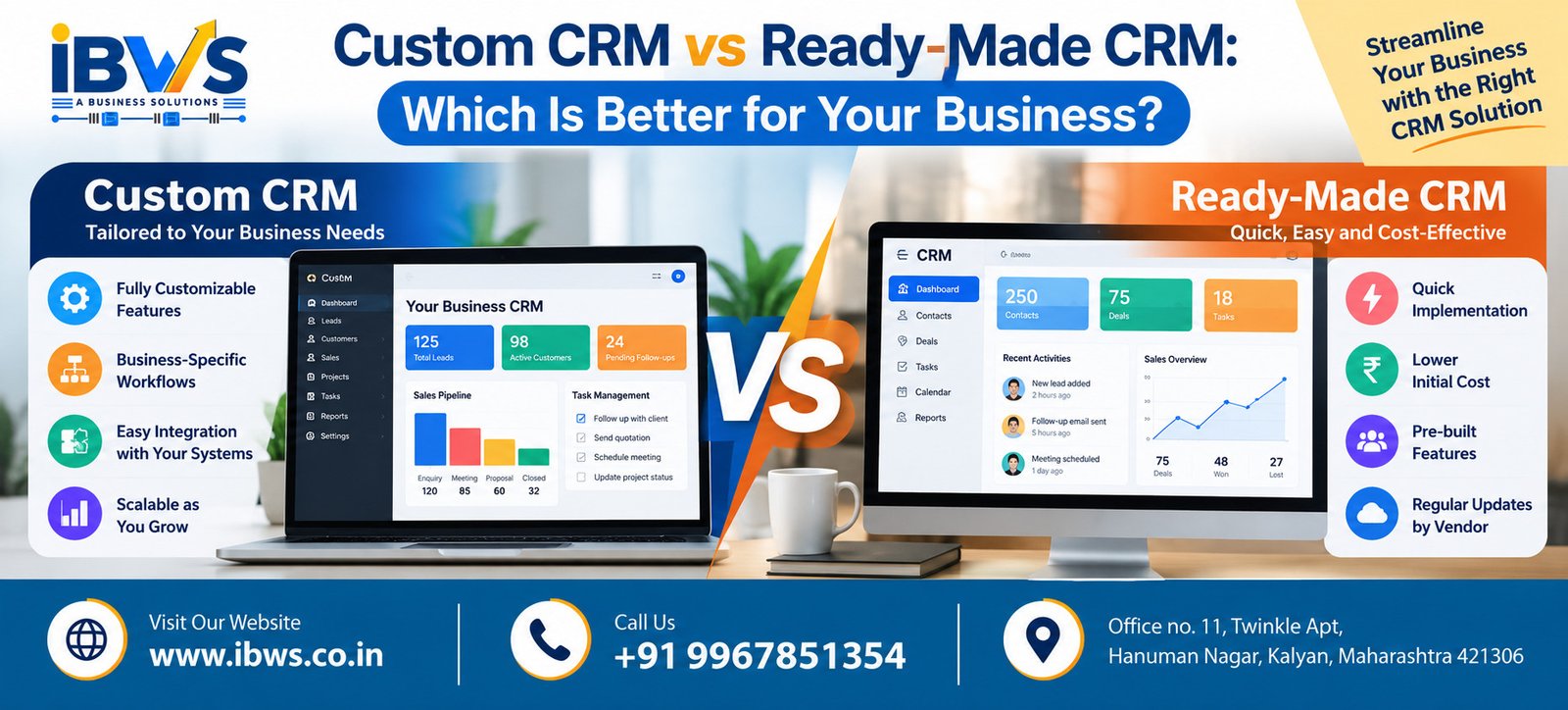
Custom CRM vs Ready Made CRM: Key Differences
Understanding the main differences between these two CRM approaches can help businesses make informed decisions.
| Features | Custom CRM | Ready-Made CRM |
|---|---|---|
| Development | Built for specific requirements | Pre-developed software |
| Customization | Designed around business workflows | Configurable within platform capabilities |
| Initial cost | Usually higher | Often lower |
| Implementation | Generally requires more time | Often faster |
| Scalability | Depends on architecture | Depends on platform and plan |
| Maintenance | Managed by owner or development partner | Core platform managed by vendor |
| Integration | Developed according to requirements | Prebuilt and API integrations may be available |
| User interface | Can be designed for specific teams | Uses an existing interface with configuration options |
| Pricing | Development, hosting, support and upgrades | Subscription, setup, add-ons and support |
| Best suited for | Specialized business processes | Common sales and customer management needs |
Both approaches can be effective when selected according to the organization’s requirements.
1. Custom CRM vs Ready-Made CRM: Customization and Flexibility
Customization is one of the most important factors when comparing CRM software solutions.
Custom CRM Software
Custom CRM development allows businesses to design workflows according to their operational requirements.
For example, a company may need specialized lead assignment rules, multiple approval levels, customer-specific pricing, or service management modules.
These features can be planned during development rather than adapting every process to an existing software structure.
Ready-Made CRM Software
Ready-made CRM platforms generally provide standard features and configuration options.
Many platforms allow businesses to customize fields, dashboards, pipelines, automation rules, and user permissions.
However, advanced requirements may involve additional subscriptions, extensions, or development work.
Which Is Better?
Custom CRM is worth considering when business workflows cannot be adequately supported by existing platforms. Ready-made CRM is often sufficient when standard configuration can meet operational requirements.
2. Custom CRM vs Ready-Made CRM: Cost Comparison
Budget plays a significant role in CRM software selection.
Custom CRM Development Cost
Custom CRM development generally involves an initial investment in planning, design, programming, testing, and deployment.
Additional expenses may include hosting, maintenance, technical support, security updates, and future enhancements.
The cost depends on project complexity, required modules, integrations, and development resources.
Ready-Made CRM Software Cost
Ready-made CRM platforms commonly use monthly or annual subscription models.
Costs may depend on the number of users, selected features, storage requirements, integrations, and subscription tiers.
Businesses should also consider onboarding, customization, data migration, and training expenses.
Which Is Better?
Ready-made CRM often offers a lower initial investment. Custom CRM may become financially attractive when specialized workflows or recurring platform costs justify development.
3. Custom CRM vs Ready-Made CRM: Implementation Time
Implementation time affects how quickly employees can begin using a CRM system.
Custom CRM Implementation
A custom CRM usually requires several development stages, including requirement analysis, interface design, database planning, programming, testing, and deployment.
Complex systems may require phased implementation.
Ready-Made CRM Implementation
Ready-made CRM software can often be configured more quickly because the core application already exists.
However, data migration, employee training, integrations, and advanced customization can extend implementation time.
Which Is Better?
Ready-made CRM is generally preferable when rapid deployment is a priority. Custom CRM may be more suitable when specialized functionality is essential.
4. Custom CRM vs Ready-Made CRM: Scalability
Scalability refers to a system’s ability to support business growth.
Custom CRM Scalability
A properly designed custom CRM can support additional users, departments, workflows, and business modules.
However, scalability must be considered during system architecture and development.
Ready-Made CRM Scalability
Many ready-made CRM platforms offer subscription tiers and enterprise features that support growing organizations.
Additional capabilities may require higher-tier plans or paid extensions.
Which Is Better?
Both solutions can scale effectively. The decision depends on expected growth, technical requirements, pricing, and platform limitations.
5. Custom CRM vs Ready-Made CRM: Data Security
CRM systems often store important customer information, including contact details, communication records, sales history, and business transactions.
Custom CRM Security
A custom CRM allows organizations to define security requirements and select appropriate hosting arrangements.
However, secure development, access controls, backups, vulnerability management, and ongoing maintenance must be implemented properly.
Ready-Made CRM Security
Established CRM vendors commonly provide built-in security features such as authentication, access controls, backups, and platform maintenance.
Specific protections depend on the provider and subscription plan.
Which Is Better?
Neither approach is automatically more secure. Businesses should evaluate actual security controls, data handling practices, access permissions, and applicable legal requirements.
6. Custom CRM vs Ready-Made CRM: Integration Capabilities
Modern businesses use multiple software applications for accounting, communication, marketing, inventory, and employee management.
Custom CRM Integration
Custom CRM software can be developed to connect with selected business systems through available APIs or other supported integration methods.
This may be valuable for organizations with specialized software environments.
Ready-Made CRM Integration
Many ready-made CRM platforms provide prebuilt integrations with commonly used business applications.
Additional integrations may be possible through APIs or third-party tools.
Which Is Better?
Ready-made CRM is often convenient when existing integrations meet business requirements. Custom CRM can be considered when specialized integrations are necessary.
7. Custom CRM vs Ready-Made CRM: Maintenance and Support
Maintenance is an important part of long-term CRM performance.
Custom CRM software requires an ongoing plan for bug fixes, hosting, security updates, backups, and improvements.
Ready-made CRM vendors typically maintain their core platforms, although businesses remain responsible for configuration, user management, data quality, and certain integrations.
Businesses should consider support arrangements before selecting either solution.
Benefits of Custom CRM Software for Businesses
Custom CRM development can provide several advantages when a business has specialized operational requirements.
1. Business-Specific Workflows
A custom CRM can be designed to follow the organization’s existing processes instead of requiring extensive workflow changes.
2. Tailored Customer Management
Businesses can organize customer information, lead stages, follow-up activities, and reporting fields according to their requirements.
3. Specialized Automation
Custom automation can support activities such as lead assignment, service scheduling, approval workflows, and recurring follow-up reminders.
4. Customized Reporting
Businesses can develop dashboards and reports around the performance indicators that matter to their operations.
5. Flexible Integration Planning
A custom CRM can be planned around selected accounting, inventory, service management, and other business applications.
6. Long-Term Development Flexibility
Organizations may introduce additional modules as requirements change, subject to technical feasibility and development resources.
Benefits of Ready-Made CRM Software
Ready-made CRM software offers practical advantages for businesses with common customer management requirements.
1. Faster Initial Setup
Prebuilt features can reduce the time required to begin using a CRM system.
2. Lower Initial Investment
Subscription plans often allow businesses to start without funding a complete software development project.
3. Established Features
Many platforms provide mature sales, customer management, and reporting capabilities.
4. Vendor-Managed Updates
Core software updates and infrastructure maintenance are generally handled by the platform provider.
5. Available Integrations
Established CRM platforms may offer integration marketplaces and standard connectors.
6. Training Resources
Popular CRM platforms often provide documentation, tutorials, and user communities.
When Should Your Business Choose a Custom CRM?
A Custom CRM Software solution is ideal for businesses with unique workflows, complex operations, and specific customer management requirements. It allows companies to customize features such as lead tracking, sales automation, reporting, and third-party integrations according to their needs. Businesses requiring industry-specific functionalities or advanced automation can benefit from custom CRM development. A custom CRM can also support long-term business growth when designed with scalability in mind. IBWS helps businesses explore CRM software solutions tailored to their operational requirements.
When Should Your Business Choose Ready-Made CRM?
Ready-Made CRM Software is a suitable option for startups, small businesses, and companies that need a quick and cost-effective customer management solution. It offers prebuilt features such as contact management, sales tracking, lead management, and reporting without requiring extensive software development. Businesses with standard workflows can benefit from faster implementation, subscription-based pricing, and vendor-managed updates. Ready-made CRM platforms also offer configuration options and integrations to support common business requirements. For companies seeking an easy-to-implement CRM solution, ready-made software can be a practical choice.
Custom CRM vs Ready-Made CRM for Small Businesses
Small businesses often require basic customer management, lead tracking, sales follow-ups, and reporting.
If these requirements are straightforward, ready-made CRM software may provide an economical and convenient solution.
However, a small business with highly specialized processes may still benefit from a custom CRM.
The important factor is not business size alone but the complexity of the workflow and the value of customization.
Custom CRM vs Ready-Made CRM for Growing Companies
As businesses grow, they may need additional users, more advanced reporting, department-specific workflows, and integration with other systems.
Ready-made CRM platforms can support many of these requirements through additional modules and subscription plans.
However, businesses with complex operational processes may encounter limitations that require significant customization.
At this stage, comparing the total cost and capabilities of both approaches becomes particularly important.
Custom CRM vs Ready-Made CRM for Service-Based Businesses
Service-based businesses often need more than traditional sales pipeline management.
Their workflows may include customer enquiries, quotation preparation, employee allocation, service scheduling, recurring contracts, complaint tracking, and payment follow-ups.
A standard CRM may support some of these processes through configuration or integrations.
A custom CRM can be considered when the business requires tightly connected workflows that existing platforms cannot provide efficiently.
For example, pest control companies, maintenance providers, and field service businesses may benefit from software designed around recurring service appointments and operational tracking.
Is a Hybrid CRM Solution a Better Option?
Businesses do not always need to choose between building an entirely new CRM and using an unmodified ready-made platform.
A hybrid approach combines an existing CRM platform with selected custom modules, integrations, or workflows.
For example, a business may use a ready-made CRM for contact management while developing a custom portal for service scheduling or customer reporting.
This approach can reduce development requirements while preserving essential customization.
The suitability of a hybrid system depends on platform capabilities, integration complexity, maintenance costs, and long-term requirements.
How to Choose the Right CRM Software for Your Business
Before investing in CRM software, businesses should complete a structured evaluation.
Step 1: Identify Your Business Requirements
List the customer management activities, sales processes, reports, and workflows that the system must support.
Step 2: Define Your Budget
Consider initial setup, subscription fees, development costs, training, integrations, and ongoing maintenance.
Step 3: Evaluate Essential Features
Identify which CRM features are mandatory and which can be added later.
Step 4: Review Integration Requirements
Check compatibility with existing accounting, marketing, communication, and operational systems.
Step 5: Consider Future Business Growth
Estimate future user requirements, data volume, departments, and additional functionality.
Step 6: Assess Security and Data Management
Review access controls, backup procedures, data portability, and applicable privacy requirements.
Step 7: Compare Total Cost of Ownership
Calculate the expected cost over three to five years rather than comparing only initial prices.
Step 8: Plan Employee Training
Choose a system employees can understand and use consistently.
Common Mistakes to Avoid When Selecting CRM Software
Businesses should avoid making CRM decisions based only on advertising claims or initial pricing.
Common mistakes include:
- Selecting software without defining business requirements.
- Paying for features employees will not use.
- Underestimating implementation and training costs.
- Ignoring data migration requirements.
- Overlooking integration limitations.
- Failing to evaluate data security.
- Assuming custom software requires no maintenance.
- Ignoring future scalability.
- Choosing a CRM without testing important workflows.
- Failing to establish clear ownership of customer data and export procedures.
A carefully planned CRM implementation can reduce unnecessary expenses and improve adoption.
Why Choose IBWS for CRM Software Solutions?
Every business has different customer management requirements, operational processes, and growth objectives.
At IBWS, we understand the importance of selecting software that supports business operations efficiently.
Whether your company is evaluating custom CRM development, business management software, or a configurable CRM solution, the first step is identifying the features and workflows that matter most.
Businesses should evaluate customer management, lead tracking, workflow automation, reporting, integration requirements, and long-term maintenance before making a decision.
Visit IBWS to explore business software solutions and discuss your requirements.
Conclusion: Custom CRM vs Ready-Made CRM – Making the Right Decision
The Custom CRM vs Ready Made CRM comparison highlights that both solutions have advantages and limitations.
Ready-made CRM software can be an effective choice for businesses that need established features, faster implementation, and predictable subscription-based access.
Custom CRM software may be more suitable for organizations with specialized workflows, complex integration requirements, or business processes that cannot be efficiently supported by existing platforms.
A configurable or hybrid CRM approach may also provide a practical balance between functionality and cost.
Before selecting a solution, businesses should carefully evaluate their workflows, budget, security requirements, employee needs, and long-term growth plans.
At IBWS, we believe that the right CRM solution should support your business processes and help your team manage customer relationships more effectively.
Contact IBWS
IBWS – Business Software Solutions
Phone: +91 9967851354
Website: https://ibws.co.in/
Address: Office No. 11, Twinkle Apt, Hanuman Nagar, Kalyan, Maharashtra – 421306
Looking for CRM software that fits your business requirements? Contact IBWS to discuss your customer management and workflow needs.
Custom CRM vs Ready Made CRM Custom CRM vs Ready Made CRM Custom CRM vs Ready Made CRM Custom CRM vs Ready Made CRM Custom CRM vs Ready Made CRM Custom CRM vs Ready Made CRM Custom CRM vs Ready Made CRM Custom CRM vs Ready Made CRM Custom CRM vs Ready Made CRM Custom CRM vs Ready Made CRM Custom CRM vs Ready Made CRM Custom CRM vs Ready Made CRM Custom CRM vs Ready Made CRM Custom CRM vs Ready Made CRM Custom CRM vs Ready Made CRM Custom CRM vs Ready Made CRM