
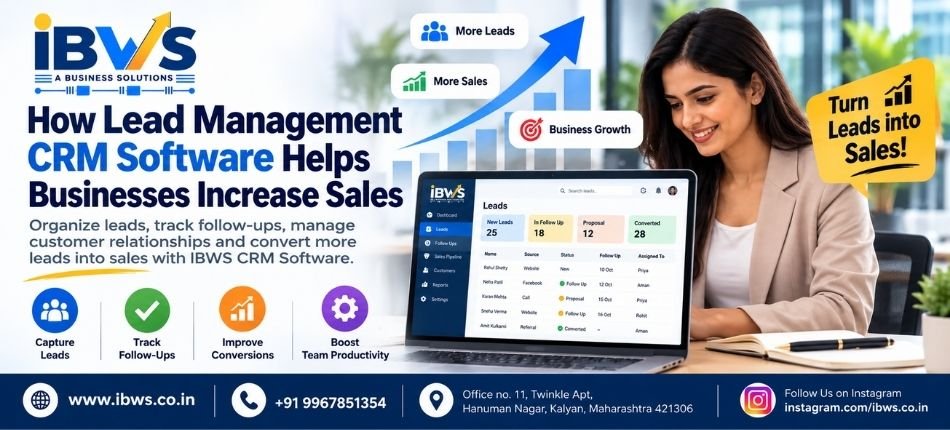
How Lead Management CRM Software Helps Businesses Increase Sales – IBWS
Introduction
Lead Management CRM Software helps businesses organize customer enquiries, track follow-ups, manage sales pipelines, and improve lead conversions. Many businesses lose potential customers due to missed follow-ups, delayed responses, and unorganized lead information. With IBWS, businesses can streamline their sales processes, improve team productivity, and manage customer relationships more efficiently. An effective CRM system helps sales teams focus on valuable opportunities and increase sales through better lead management.
Generating leads is important for every business, but converting those leads into paying customers is what drives revenue. Many businesses receive enquiries through websites, phone calls, WhatsApp, social media, and advertising campaigns. However, without a proper system to manage these enquiries, potential customers can easily be overlooked.
Missed follow-ups, scattered customer information, delayed responses, and poor sales coordination are common challenges that affect business growth.
This is where Lead Management CRM Software becomes valuable.
IBWS – A Business Solutions provides CRM solutions designed to help businesses organize customer enquiries, manage sales activities, track follow-ups, and monitor opportunities through a centralized system.
By using Lead Management CRM Software effectively, businesses can improve their sales processes, strengthen customer relationships, and increase their chances of converting enquiries into successful deals.
Follow IBWS on Instagram for useful insights about Lead Management CRM Software, sales automation, customer relationship management, and business growth.
1. What Is Lead Management CRM Software?
Lead Management CRM Software is a digital solution that helps businesses capture, organize, track, and manage potential customers throughout the sales process.
Instead of maintaining customer details across multiple Excel sheets, notebooks, emails, and messaging applications, a CRM provides a centralized location for important lead information.
A typical lead record can include:
-
Customer name and contact details
-
Lead source, such as website, advertisement, or referral
-
Product or service requirements
-
Lead status and sales priority
-
Assigned sales representative
-
Previous communication history
-
Next follow-up date
-
Estimated deal value
-
Final conversion status
For example, when a customer enquires about a service, the sales team can create a lead record, assign it to the appropriate employee, schedule a follow-up, and update the enquiry status as discussions progress.
This structured approach helps businesses maintain better control over their sales activities.
2. Centralized Lead Management Prevents Missed Opportunities
One of the biggest problems businesses face is managing enquiries received through different communication channels.
A potential customer might submit a website enquiry, another might contact the company through WhatsApp, while others may call directly or respond to an advertisement.
When these enquiries are handled separately, sales representatives may lose important customer information or accidentally overlook potential buyers.
How CRM helps:
A centralized CRM system allows sales teams to maintain customer records in one location. Where integrations are supported, enquiries from multiple channels can also be captured automatically.
This helps businesses:
-
Reduce duplicate customer records
-
Access customer information quickly
-
Track enquiry sources
-
Identify pending leads
-
Maintain communication history
-
Assign responsibility for every enquiry
Practical example:
A real estate company receives 50 enquiries in one day from property portals, social media advertisements, and direct calls.
Without CRM software, the team may struggle to remember which customers requested site visits and which enquiries require follow-ups.
With a centralized CRM, the company can organize these leads according to property requirements, budgets, preferred locations, and sales status.
As a result, sales representatives can prioritize interested buyers instead of repeatedly searching for customer information.
3. Faster Follow-Ups Improve Lead Conversion Opportunities
Timely follow-ups play an important role in converting potential customers into paying clients.
A customer who enquires about a product or service may also contact several competitors. If a business takes too long to respond, the customer may choose another provider.
Lead Management CRM Software helps sales teams maintain a structured follow-up process.
How CRM improves follow-up management
Follow-up scheduling: Sales representatives can record the next communication date for every lead.
Reminders and notifications: CRM systems with reminder features can alert employees about upcoming or overdue follow-ups.
Communication history: Sales representatives can review previous discussions before contacting customers.
Lead prioritization: Interested customers can be identified and contacted according to their urgency or buying potential.
Pending lead tracking: Managers can identify enquiries that have not received appropriate attention.
Example
A customer enquires about website development services but wants to discuss the project after three days.
Without a proper tracking system, the sales representative may forget to contact the customer.
With CRM software, the employee can schedule a follow-up for the agreed date and review the customer’s requirements before making the call.
This creates a more professional customer experience and reduces the risk of losing interested prospects.
4. Sales Pipeline Tracking Helps Businesses Close More Deals
A sales pipeline represents the different stages a potential customer passes through before making a purchase.
Lead Management CRM Software allows businesses to track these stages and understand how enquiries progress toward conversion.
A practical sales pipeline may look like this:
New Enquiry
Contacted
Qualified
Proposal Sent
Negotiation
Closed
Tracking these stages provides useful information about sales performance.
For example, if many customers reach the proposal stage but very few make purchases, the business can investigate possible reasons.
The issue might involve pricing, unclear proposals, delayed communication, or a mismatch between customer expectations and the offered solution
Benefits of Sales Pipeline Tracking
Sales pipeline tracking helps businesses monitor every stage of the customer journey, from the initial enquiry to the final purchase. With Lead Management CRM Software, sales teams can easily identify potential customers, track pending quotations, monitor follow-up activities, and prioritize high-value opportunities. It also helps managers understand where leads are getting delayed and which stages require improvement. By maintaining clear visibility into ongoing sales activities, businesses can reduce missed opportunities, improve team coordination, make better sales forecasts, and increase their chances of converting leads into paying customers.
5. Better Lead Qualification Saves Time and Resources
Not every enquiry has the same likelihood of becoming a customer.
Some people are ready to purchase immediately, while others are comparing options, researching prices, or planning for future requirements.
Treating every lead with the same priority can reduce sales efficiency.
Lead Management CRM Software helps businesses categorize enquiries according to their potential.
| Lead Type | Customer Behaviour | Recommended Action |
|---|---|---|
| Hot Lead | Ready to purchase soon | Immediate follow-up |
| Warm Lead | Interested but comparing options | Share details and schedule follow-up |
| Cold Lead | Exploring future requirements | Maintain contact appropriately |
| Unqualified Lead | Requirements do not match the offering. | Record reason and close or reclassify. |
Why lead qualification matters
By identifying serious buyers, sales representatives can spend more time on customers who are more likely to convert.
For example, a customer who has confirmed their budget, requirements, and purchase timeline may deserve higher priority than someone requesting only general information.
This does not mean ignoring other enquiries. It means organizing follow-ups according to customer needs and business opportunities.
A structured qualification process improves productivity and makes sales activities more focused.
6. Improved Sales Team Productivity and Accountability
Managing a sales team becomes challenging when multiple employees handle enquiries independently.
Managers may struggle to understand which employee is responsible for a lead, how many follow-ups are pending, and which sales opportunities require attention.
A CRM helps establish a more organized workflow.
Important benefits for sales teams
Lead assignment: Managers can allocate enquiries to specific sales representatives.
Activity tracking: Sales activities, customer discussions, and follow-up updates can be recorded.
Reduced manual work: Repetitive administrative tasks can be simplified, depending on the CRM’s available features.
Better coordination: Employees can access relevant customer information without repeatedly requesting details from colleagues.
Performance monitoring: Managers can evaluate sales activities using available reports and dashboards.
For businesses handling a large number of daily enquiries, these capabilities can reduce confusion and help employees concentrate on customer communication and sales conversion.
7. CRM Reports Help Businesses Make Better Sales Decisions
CRM reports provide businesses with valuable insights into lead generation, sales performance, customer behaviour, and conversion rates. Instead of relying on assumptions or manually checking multiple records, managers can use Lead Management CRM Software to analyze important information such as total enquiries, qualified leads, pending follow-ups, completed sales, and individual employee performance. These reports also help businesses identify which marketing channels generate quality leads and where improvements are needed in the sales process. By regularly reviewing CRM data, companies can allocate resources more effectively, improve sales strategies, reduce unnecessary expenses, and make informed decisions that support long-term business growth.
8. How Lead Management CRM Software Improves Customer Relationships
Building strong customer relationships is essential for increasing sales, encouraging repeat business, and maintaining customer satisfaction. Lead Management CRM Software helps businesses maintain organized customer information, including previous conversations, product enquiries, purchase interests, and follow-up history. This allows sales representatives to understand customer requirements and provide more personalized communication without repeatedly asking for the same details. CRM software also supports timely follow-ups, better coordination between employees, and consistent customer service throughout the sales journey. When customers receive relevant information, prompt responses, and professional assistance, they are more likely to develop trust in the business, resulting in stronger relationships, improved customer retention, and more opportunities for future sales.
9. How CRM Helps Businesses Reduce Lead Leakage
Lead leakage happens when a potential customer is lost because an enquiry is not properly captured, assigned, followed up, or tracked.
This is particularly common in businesses that depend on manual records and unorganized communication.
Common reasons for lead leakage
| Problem | How CRM Helps |
|---|---|
| Missed customer enquiries | Maintains centralized lead records |
| Forgotten follow-ups | Supports scheduled follow-up tracking |
| Unassigned leads | Helps assign responsibility |
| Duplicate enquiries | Supports checking and organizing records |
| Lost communication details | Maintains customer interaction history |
| Untracked quotations | Records sales stages and pending proposals |
For example, a business might spend money on Google Ads to generate enquiries. However, if its sales team fails to contact those prospects, part of the advertising investment may be wasted.
By combining a structured lead management process with CRM software, businesses can improve how they handle the enquiries they have already paid to generate.
10. Which Businesses Can Benefit from Lead Management CRM Software?
Lead Management CRM Software is useful for organizations that receive regular customer enquiries and require consistent follow-ups.
Real Estate Businesses
Real estate agents and developers can organize property enquiries, customer budgets, preferred locations, site visit schedules, and booking discussions.
Healthcare Clinics
Clinics can manage non-clinical enquiries, appointment requests, and service-related follow-ups while following appropriate patient privacy and data protection practices.
Educational Institutes
Coaching classes and training institutes can track admission enquiries, course interests, counselling appointments, and pending registrations.
Digital Marketing Agencies
Agencies can manage enquiries for SEO, website development, advertising, and other services while monitoring quotations and project discussions.
Manufacturers and Suppliers
Manufacturing businesses can track product enquiries, quotation requests, bulk orders, distributor communications, and sales opportunities.
Service-Based Businesses
Interior designers, consultants, maintenance providers, and other service companies can organize customer requirements, scheduled visits, quotations, and pending approvals.
The main advantage is that every business can create a structured sales process based on its own customer journey.
11. How to Choose the Right Lead Management CRM Software
Selecting CRM software should depend on your business requirements, team size, and sales workflow.
Before choosing a solution, consider the following factors.
Ease of Use: The CRM should have a straightforward interface so employees can update leads without extensive technical knowledge.
Lead Management Features: Check whether the software supports lead records, assignment, status tracking, and follow-up scheduling.
Sales Pipeline Visibility: Look for a system that allows employees and managers to understand the progress of active sales opportunities.
Reports and Dashboards: Ensure that the available reporting features provide the information your business needs.
Integration Requirements: If your business receives enquiries through websites, WhatsApp, or advertising platforms, verify which integrations are supported.
Data Security: Review access permissions, data protection arrangements, backup options, and how customer information is handled.
Scalability: Choose software that can accommodate more employees, customers, and enquiries as the business grows.
Implementation and Support: Consider the assistance available for setup, employee training, and ongoing technical support.
The right CRM should simplify daily sales activities rather than introduce unnecessary complexity.
12. How to Implement Lead Management CRM Software Successfully
Purchasing CRM software alone does not guarantee better sales performance. Businesses must also establish clear processes and ensure that employees use the system consistently.
A practical implementation process includes five steps.
-
Define your sales stages: Identify how customers move from initial enquiry to final purchase.
-
Organize existing lead data: Remove unnecessary duplicates and prepare accurate customer records.
-
Assign responsibilities: Decide who will manage new enquiries, follow-ups, quotations, and reporting.
-
Train your sales team: Explain how to update lead statuses, record customer discussions, and schedule follow-ups.
-
Review performance regularly: Monitor overdue follow-ups, conversion rates, and sales pipeline progress.
Managers should also establish simple rules, such as ensuring every qualified lead has an assigned employee and a clearly recorded next action.
Consistent CRM usage is essential for maintaining accurate information and improving sales efficiency.
13. Why Choose IBWS for Lead Management CRM Software?
IBWS – A Business Solutions offers business software solutions focused on helping organizations manage their operations more effectively.
For companies looking to improve lead management, a CRM solution can provide a more structured approach to handling customer enquiries and sales activities.
Businesses evaluating IBWS can discuss their requirements for lead organization, follow-up management, sales pipeline tracking, team coordination, and reporting.
The suitability of individual features, integrations, and customization options should be confirmed directly with IBWS before implementation.
Contact IBWS to discuss a CRM solution suited to your business workflow.
Conclusion
Lead Management CRM Software plays an important role in helping businesses manage customer enquiries, organize follow-ups, monitor sales opportunities, and improve team productivity.
Instead of depending on scattered spreadsheets and manual reminders, businesses can establish a structured process that makes customer information easier to access and sales activities easier to monitor.
From lead capture and qualification to pipeline management and performance reporting, CRM software provides the visibility needed to make more informed sales decisions.
For businesses aiming to increase sales, the goal should not simply be to generate more enquiries. It should also be to manage existing opportunities effectively and improve the customer experience throughout the sales journey.
IBWS – A Business Solutions can be contacted to explore Lead Management CRM Software for your organization.