
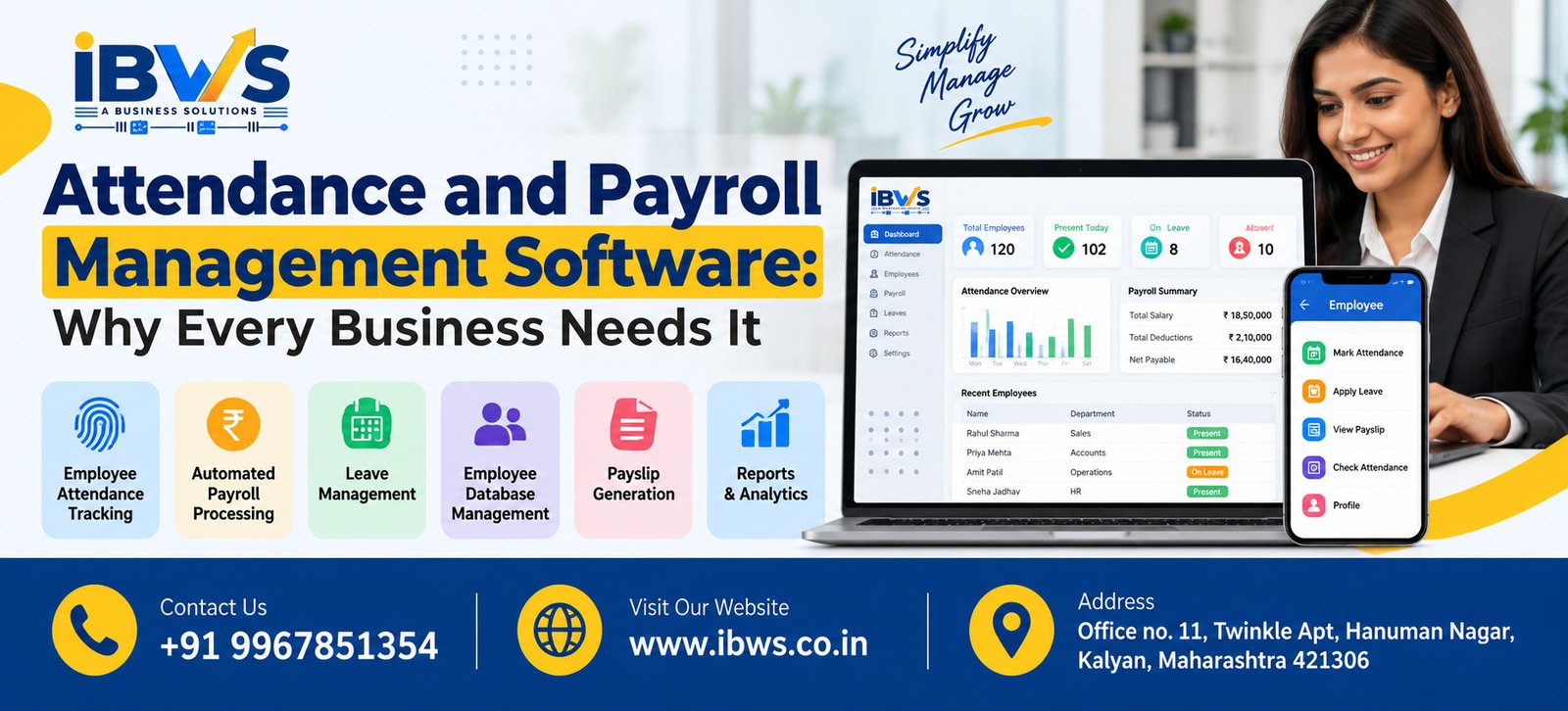
Attendance and Payroll Management Software: Why Every Business Needs It – IBWS
Introduction
Attendance and Payroll Software is an essential business solution that helps organizations automate employee attendance tracking, salary calculations, leave management, and payroll processing. Whether a business has 10 employees or 1,000, managing workforce records manually can be time-consuming and prone to errors. Modern attendance and payroll management systems simplify HR operations, improve payroll accuracy, and reduce administrative workload, allowing businesses to focus on productivity and growth.
Traditional attendance registers, spreadsheets, and manual salary calculations are time-consuming and prone to human errors. Even a small mistake in attendance tracking or payroll processing can lead to employee dissatisfaction, financial discrepancies, and administrative challenges.
This is where Digital HR Solution becomes an essential business solution. Businesses can also streamline recruitment and employee management processes by exploring Job Consultancy CRM Software solutions offered by IBWS.
Modern attendance and payroll management software automates employee attendance tracking, working-hour calculations, leave management, salary processing, and payroll reporting through a centralized digital system.
For businesses looking to improve productivity, reduce administrative workload, and maintain accurate employee records, implementing reliable attendance and payroll management software is a smart investment.
In this blog, we will explore how works, its important features, major benefits, and why businesses of every size should consider adopting it.
1. What Is Attendance and Payroll Management Software?
Attendance and payroll management software is a digital solution designed to simplify and automate employee attendance tracking and salary processing.
Instead of maintaining separate records for attendance, leaves, overtime, and salaries, businesses can manage these activities through a centralized platform.
Digital HR Solution helps organizations maintain accurate employee information while reducing manual administrative tasks.
The software generally includes features such as:
- Employee attendance tracking
- Daily check-in and check-out records
- Employee working-hour calculations
- Leave and holiday management
- Overtime calculation
- Salary and wage processing
- Payroll deductions and allowances
- Payslip generation
- Employee record management
- Attendance and payroll reporting
By integrating attendance records with payroll calculations, businesses can reduce repetitive data entry and improve accuracy in salary processing.
2. Why Traditional Attendance and Payroll Management Is No Longer Enough
Many small and medium-sized businesses still depend on manual attendance registers or Excel spreadsheets to manage employee records.
Although these methods may work for a limited number of employees, they become increasingly difficult to maintain as an organization grows.
Common Challenges of Manual Attendance Management
Human Errors: Manual data entry increases the possibility of incorrect attendance records, missing entries, and calculation mistakes.
Time-Consuming Processes: HR departments spend considerable time reviewing attendance sheets, calculating working hours, and preparing salary statements.
Payroll Calculation Errors: Incorrect leave deductions, overtime calculations, or salary adjustments may result in inaccurate employee payments.
Limited Transparency: Employees may find it difficult to verify their attendance, leave balances, and salary deductions.
Difficult Record Management: Maintaining employee records across multiple files makes information retrieval and reporting complicated.
Delayed Salary Processing: Manual payroll calculations may cause delays, especially when businesses have large workforces.
Implementing attendance and payroll management software helps organizations address these challenges through automation and centralized employee data management.
3. Key Features of Employee Management System
A reliable Employee Management System solution should provide features that simplify employee management and improve operational efficiency.
A. Automated Employee Attendance Tracking
Automated attendance tracking allows businesses to record employee working hours without relying entirely on manual registers.
Depending on the software and connected devices, attendance can be recorded through biometric systems, RFID cards, mobile applications, or web-based check-in methods.
The system can maintain records of employee check-in times, check-out times, late arrivals, early departures, and absences.
This helps HR teams monitor attendance more efficiently and maintain accurate records.
B. Automated Payroll Processing
Payroll processing involves calculating employee salaries based on attendance, working days, overtime, allowances, and deductions.
Automated HR Platform can automate these calculations according to configured company policies.
Automated payroll processing helps businesses:
- Calculate employee salaries accurately.
- Apply leave and absence deductions.
- Include overtime payments and allowances.
- Generate monthly salary statements.
- Reduce repetitive calculations.
- Process payroll more efficiently.
C. Leave and Holiday Management
Managing employee leave manually can create confusion, especially when several employees request leave during the same period.
Workforce Management Solution can provide a structured leave management system.
Employees may submit leave requests digitally, while authorized managers can review and approve them.
The system can also maintain leave balances, holiday calendars, and approved leave records.
D. Overtime and Shift Management
Businesses operating multiple shifts often face difficulties calculating employee working hours and overtime.
Attendance and payroll management software can simplify shift scheduling and overtime calculations.
Depending on the system’s capabilities, organizations can configure shift timings, overtime rules, weekly offs, and working-hour policies.
This is particularly useful for manufacturing companies, security agencies, healthcare facilities, and businesses operating around the clock.
E. Employee Database Management
Employee Database Management is an essential feature of Workforce Management Solution that helps businesses store and organize employee information in one centralized system. It maintains important details such as employee IDs, departments, designations, joining dates, salary structures, attendance records, and leave history. HR teams can easily access, update, and manage employee information without relying on multiple spreadsheets or manual records. This improves data accuracy, reduces administrative workload, and ensures better organization of employee records. A secure employee database also helps businesses streamline payroll processing and improve overall HR efficiency.
F. Salary Slip Generation
Generating individual salary slips manually can take considerable time.
Payroll software can automatically generate employee payslips containing salary details, allowances, deductions, and net payable amounts.
Digital payslips improve accessibility and help employees understand their monthly salary calculations.
G. Reports and Analytics
Digital Payroll System can generate reports that help business owners and HR managers make informed decisions.
Common reports include attendance summaries, employee absenteeism reports, overtime reports, monthly payroll statements, and department-wise salary expenses.
These reports provide better visibility into workforce management and operational costs.
4. Top Benefits of Attendance and Payroll Software for Businesses
1. Saves Time and Administrative Effort
One of the biggest advantages of attendance and payroll software is automation.
HR teams no longer need to manually calculate every employee’s attendance, working hours, and salary adjustments.
Automated processes allow employees to focus on recruitment, employee engagement, training, and other important HR activities.
2. Improves Payroll Accuracy
Manual payroll calculations can lead to mistakes in salary payments, overtime calculations, and leave deductions.
By connecting attendance data with payroll processing, software can reduce calculation errors and improve salary accuracy.
However, organizations must configure salary structures, attendance policies, and statutory rules correctly.
3. Enhances Employee Transparency
Employees appreciate clear and accurate attendance and salary records.
A software platform with employee self-service features can allow staff members to view their attendance, leave balances, and payslips.
Greater transparency can reduce payroll-related confusion and improve employee confidence.
4. Reduces Operational Costs
Manual attendance and payroll management requires administrative time and resources.
Automating repetitive processes can reduce paperwork, improve efficiency, and minimize the cost of correcting avoidable errors.
Over time, these improvements can contribute to better operational cost management.
5. Supports Business Growth
As businesses expand, managing attendance and payroll for additional employees becomes more challenging.
Scalable attendance and payroll software can help organizations handle larger workforces without proportionally increasing administrative work.
6. Improves Data Security
Employee payroll information includes sensitive personal and financial details.
A well-designed software system can provide role-based access controls, secure authentication, backups, and activity logs.
Businesses should evaluate the security and privacy practices of their software provider before implementation.
7. Helps Maintain Compliance Records
Businesses in India may need to maintain records related to Provident Fund (PF), Employee State Insurance (ESI), Professional Tax, Tax Deducted at Source (TDS), and other applicable statutory requirements.
Payroll software with appropriate compliance features can assist in calculating deductions and maintaining relevant records.
However, compliance requirements vary by organization, employee eligibility, location, and applicable laws. Software does not replace professional compliance verification.
5. How Attendance and Payroll Software Works
Attendance and payroll management software generally follows a structured workflow.
Step 1: Employee Registration
The HR department adds employee information, departments, salary structures, and applicable attendance policies to the software.
Step 2: Attendance Recording
Employees record their attendance using supported check-in methods, such as biometric devices, web portals, or mobile applications.
Step 3: Attendance Verification
The system processes attendance records, working hours, absences, late arrivals, and approved leave information.
Step 4: Payroll Calculation
Payroll calculations are performed using employee salary structures, attendance data, allowances, deductions, and configured payroll rules.
Step 5: Payroll Review and Approval
Authorized personnel review salary calculations and verify payroll details before final approval.
Step 6: Payslip and Report Generation
The software generates salary slips and payroll reports. Some solutions may also support integrations for payment processing and accounting.
This integrated workflow makes employee attendance and salary management more organized and efficient.
6. Why Small and Medium Businesses Need Attendance and Payroll Software
Small and medium-sized enterprises often operate with limited HR resources.
Business owners may personally manage employee attendance, leave approvals, salary calculations, and administrative records.
As employee numbers increase, these responsibilities can become difficult to handle efficiently.
Attendance and Payroll Software helps small businesses establish a professional workforce management system without relying entirely on manual processes.
For example, a business with 25 employees may need to calculate different salary amounts based on attendance, overtime, approved leaves, and individual salary structures.
Performing these calculations manually every month can consume valuable time.
With suitable software, much of the calculation process can be automated, allowing business owners to focus on customer service, sales, and business development.
7. Industries That Benefit from Attendance and Payroll Management Software
Attendance and payroll management software can support businesses across multiple industries.
Manufacturing Companies
Manufacturing businesses often operate multiple shifts and employ workers with different wage structures.
Attendance and payroll software helps manage shift attendance, overtime, working hours, and wage calculations.
Retail Businesses
Retail stores and shopping outlets require reliable attendance tracking for sales staff, supervisors, and support employees.
Automated attendance records help managers monitor workforce availability and process salaries.
Healthcare Organizations
Hospitals, clinics, and healthcare facilities often operate with rotating shifts.
Attendance and payroll management software can simplify employee attendance tracking, shift management, and salary calculations.
Educational Institutions
Schools, colleges, and coaching institutes can use attendance and payroll software to manage teaching and non-teaching staff records.
Security and Housekeeping Agencies
Security agencies and housekeeping service providers often deploy employees across multiple client locations.
Software with multi-location attendance and shift management features can help maintain employee records and calculate wages.
Corporate Offices and IT Companies
Corporate organizations can use attendance and payroll software to manage employee working hours, leave requests, payroll records, and HR reporting.
8. Attendance and Payroll Software vs Manual Payroll Management
| Features | Manual Management | Attendance and Payroll Software |
|---|---|---|
| Attendance Tracking | Registers or spreadsheets | Automated digital records |
| Salary Calculation | Manual calculations | Rule-based automation |
| Leave Management | Paperwork or separate files | Centralized leave records |
| Overtime Calculation | Manual verification | Automated where configured |
| Payslip Generation | Manual preparation | Digital payslips |
| Data Accessibility | File-dependent | Centralized authorized access |
| Reporting | Manual compilation | Automated reports |
| Scalability | Increasing administrative effort | Easier workforce expansion |
Attendance and payroll software offers a more structured approach to workforce administration, especially for organizations managing growing employee teams.
9. How to Choose the Best Attendance and Payroll Software for Your Business
Selecting the right software depends on business requirements, workforce size, payroll complexity, and operational needs.
Before choosing a solution, consider the following factors.
Ease of Use: The software should have a user-friendly interface so HR teams and employees can use it without extensive technical training.
Attendance Integration: Check whether the solution supports the attendance methods your organization requires, such as biometric devices, mobile check-ins, or web attendance.
Payroll Customization: Choose software that supports your salary structures, allowances, deductions, overtime policies, and leave rules.
Compliance Features: Verify whether the software supports applicable statutory calculations and reporting requirements.
Data Security: Evaluate access permissions, encryption, backup facilities, and data protection policies.
Scalability: Select a solution that can accommodate additional employees, departments, and branches as your business expands.
Technical Support: Reliable implementation assistance and customer support are important for resolving software-related issues.
Reporting Capabilities: Attendance summaries, payroll reports, and employee analytics can help management monitor business operations.
Choosing software based on these factors can help organizations achieve better long-term results.
10. How Attendance and Payroll Software Improves HR Productivity
Human resource departments handle several responsibilities, including employee onboarding, attendance monitoring, leave approvals, payroll processing, and employee record management.
When these activities are handled manually, HR teams spend considerable time on repetitive administrative work.
Attendance and payroll software simplifies routine processes by organizing employee information and automating calculations.
HR professionals can access attendance reports, review payroll details, manage leave requests, and generate employee records through a centralized platform.
This reduces the need to maintain multiple spreadsheets and manually transfer information between different systems.
With fewer repetitive administrative tasks, HR teams can dedicate more attention to employee development, workplace policies, and organizational growth.
11. The Importance of Accurate Attendance Data in Payroll Processing
Employee attendance directly influences payroll calculations in many organizations.
Incorrect attendance records can result in salary discrepancies, unnecessary deductions, or incorrect overtime payments.
For example, if an employee works additional hours but those hours are not recorded correctly, the payroll department may calculate the salary incorrectly.
Similarly, unrecorded approved leave may lead to an unnecessary salary deduction.
Integrated attendance and payroll software helps reduce these issues by using verified attendance information during payroll processing.
When attendance records and payroll systems are connected, organizations can improve calculation consistency and reduce administrative errors.
12. Cloud-Based Attendance and Payroll Software: A Modern Business Solution
Cloud-based attendance and payroll software allows authorized users to access workforce management information through an internet-connected platform.
Unlike traditional systems that depend on a single local computer, cloud-based solutions can support access across multiple locations.
This can be especially beneficial for businesses operating several branches or managing employees working remotely.
Depending on the platform, cloud-based software may provide centralized employee records, automated backups, remote attendance monitoring, and payroll reporting.
However, businesses should assess data protection, system availability, access controls, and subscription costs before selecting a cloud-based solution.
13. Common Mistakes Businesses Should Avoid When Implementing Payroll Software
Although attendance and payroll software offers several advantages, successful implementation requires proper planning.
Incorrect Employee Data: Entering inaccurate employee information or salary structures can create payroll errors.
Improper Attendance Policies: Businesses should configure working hours, shifts, holidays, and leave policies correctly.
Lack of Employee Training: Employees and HR staff should understand how to use the software.
Ignoring Data Security: Sensitive payroll information should be accessible only to authorized personnel.
Skipping Payroll Verification: Businesses should review payroll calculations before finalizing employee payments, especially during the initial implementation period.
Choosing Software Without Evaluating Requirements: A solution suitable for a small office may not meet the requirements of a large manufacturing organization.
Avoiding these mistakes can help businesses achieve smoother software implementation and better operational results.
14. The Future of Attendance and Payroll Management Software
Workforce management technology continues to evolve as businesses adopt digital solutions.
Modern attendance and payroll systems increasingly focus on automation, cloud accessibility, mobile integration, and improved reporting capabilities.
Some advanced platforms offer features such as automated anomaly detection, workforce analytics, configurable approval workflows, and integration with accounting or HR management systems.
These capabilities can help organizations identify attendance irregularities, improve payroll workflows, and gain better visibility into workforce operations.
As businesses continue to digitize administrative processes, attendance and payroll software is likely to remain an important component of modern workforce management.
15. Why Investing in Attendance and Payroll Software Is a Smart Business Decision
Investing in attendance and payroll software is not simply about replacing manual registers or spreadsheets.
It is about creating an organized, accurate, and efficient employee management process.
Businesses that adopt suitable software can benefit from reduced administrative workloads, more consistent payroll calculations, improved attendance visibility, and better employee record management.
For growing organizations, these improvements can help establish a stronger operational foundation.
By selecting a reliable software solution and configuring it according to business requirements, organizations can simplify everyday HR activities while supporting long-term business growth.
Conclusion
Efficient employee attendance and payroll management is essential for maintaining smooth business operations.
Manual attendance tracking and salary calculations can become increasingly complicated as organizations grow.
Attendance and Payroll Software provides a practical solution by combining attendance monitoring, leave management, salary processing, employee records, and reporting within a centralized system.
From small businesses to large enterprises, adopting attendance and payroll management software can improve administrative efficiency, reduce calculation errors, and support more transparent workforce management.
For organizations planning to modernize their HR processes, choosing the right attendance and payroll software is an important step toward improved productivity and operational efficiency.
Attendance and Payroll Software Attendance and Payroll Software Attendance and Payroll Software Attendance and Payroll Software Attendance and Payroll Software Attendance and Payroll Software Attendance and Payroll Software Attendance and Payroll Software Attendance and Payroll Software Attendance and Payroll Software Attendance and Payroll Software