
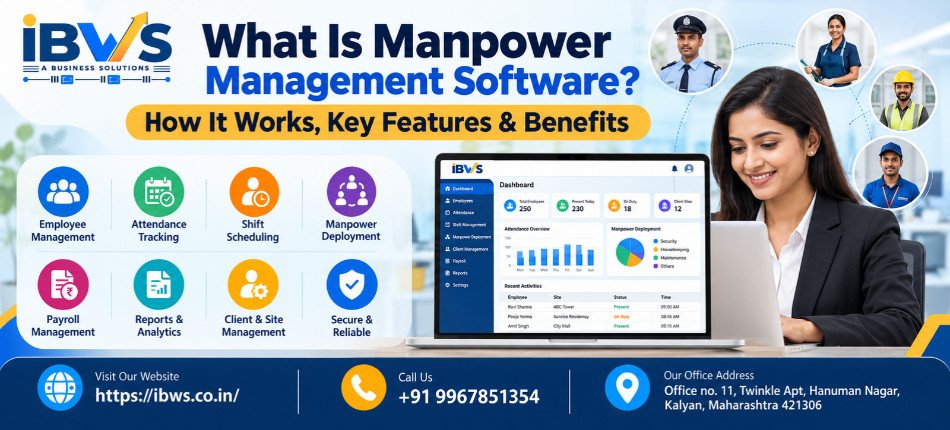
What Is Manpower Management Software? How It Works, Key Features & Benefits – IBWS
Managing employees, attendance, work schedules, payroll, and workforce allocation can become challenging as a business grows. Companies that depend on large teams, multiple work locations, or field employees often struggle with manual records, communication gaps, and administrative delays. This is where Manpower Management Software plays an important role.
Manpower Management Software is a digital solution designed to simplify workforce operations, improve employee tracking, and organize manpower deployment. Businesses looking for an efficient Manpower Management CRM Software can explore solutions from IndiaBbazaar Webmedia Services (IBWS) to manage employee records, manpower deployment, client locations, and daily operational activities more effectively.
Instead of managing employee information through spreadsheets, paperwork, and disconnected systems, businesses can use a centralized platform to monitor their workforce, reduce administrative workload, and improve operational efficiency.
In this article, we will explain what Manpower Management Software is, how it works, its key features, major benefits, and why businesses should consider implementing it to streamline workforce management.
1. What Is Manpower Management Software?
Manpower Management Software is a business management system that helps organizations plan, organize, monitor, and manage their workforce through a centralized digital platform.
It allows businesses to maintain employee information, allocate staff to different locations, track attendance, manage shifts, and monitor workforce-related activities.
For example, a security services company managing 200 security guards across multiple client locations may find it difficult to maintain accurate deployment records manually. With manpower management software, managers can organize employee assignments, review attendance records, and monitor staffing requirements from one system.
Similarly, housekeeping agencies, facility management companies, staffing agencies, and contractors can use manpower management tools to coordinate their employees and daily operations.
The main objective is to reduce administrative complexity, improve workforce visibility, and support better business decisions.
2. Why Is Manpower Management Important for Businesses?
Employees are among the most valuable resources of any organization. However, managing a growing workforce requires accurate planning, proper communication, and consistent monitoring.
When businesses depend on manual processes, they may experience problems such as inaccurate attendance records, employee scheduling conflicts, payroll errors, and inefficient manpower allocation.
Effective manpower management helps businesses maintain the right number of employees at the right locations while keeping operational information organized.
It also allows managers to identify staffing shortages, monitor employee availability, and make informed decisions about workforce requirements.
As businesses expand into multiple locations, having a centralized management system becomes increasingly valuable.
3. How Does Manpower Management Software Work?
Manpower Management Software works by collecting and organizing workforce-related information within a single digital system.
The exact workflow depends on the software and the organization’s requirements.
Step 1: Employee Registration and Database Creation
The first step involves creating employee profiles containing important details such as employee names, contact information, departments, designations, joining dates, and employment status.
Authorized managers can access these records when required, reducing dependence on physical documents.
Step 2: Workforce Allocation and Deployment
After employee registration, managers can assign workers to specific departments, projects, client sites, or locations.
For example, a housekeeping agency may deploy employees to residential complexes, corporate offices, and commercial buildings.
A manpower management system helps maintain structured records of these assignments.
Step 3: Attendance and Working Hours Tracking
Depending on the available features, employees may record attendance through mobile applications, web-based systems, biometric devices, or other supported methods.
Managers can then review attendance information, working hours, and absence records.
Step 4: Shift Scheduling and Duty Management
Businesses can prepare employee duty schedules based on staffing requirements, employee availability, and working hours.
This is particularly useful for organizations operating morning, evening, and night shifts.
Step 5: Payroll and Salary Processing
When payroll functionality or integration is available, attendance records, overtime information, and approved leave data can support salary calculations.
This helps HR teams reduce repetitive data entry and improve payroll accuracy.
Step 6: Reports and Performance Monitoring
Managers can review workforce reports, deployment records, attendance summaries, and operational information through dashboards.
These insights help businesses identify workforce-related issues and improve planning.
4. Key Features of Manpower Management Software
The functionality of manpower management systems varies between providers. However, several features are particularly valuable for businesses managing employees across multiple teams or locations.
A. Employee Database Management
Employee database management allows businesses to maintain structured records of their workforce in one place. Important information such as employee details, department assignments, job roles, joining dates, and employment status can be organized digitally. Authorized HR personnel can update employee records when changes occur, helping reduce paperwork and improve administrative efficiency.
B. Attendance Management
Attendance management helps organizations record and monitor employee presence, absences, and working hours. Depending on the software, attendance can be captured through digital check-in systems, mobile applications, or biometric integration. Managers can review attendance records and identify irregularities more easily. Accurate attendance information can also support payroll processing.
C. Shift Scheduling
Shift scheduling allows managers to organize employee duty timings according to operational requirements. Businesses can prepare schedules for different departments, locations, and work shifts. A structured scheduling system helps reduce overlapping assignments and improves staff availability. This is especially beneficial for security agencies, hospitals, housekeeping companies, and manufacturing businesses.
D. Manpower Deployment Management
Manpower deployment management helps businesses assign employees to specific projects, client locations, or work sites. Managers can maintain records of which employees are deployed, where they are working, and their assigned responsibilities. This improves coordination between administrative teams and field operations. It can also help businesses respond more efficiently to changes in staffing requirements.
E. Leave and Holiday Management
Leave management features help employees submit leave requests and allow authorized managers to review or approve them. Businesses can maintain records of approved leave, pending requests, and employee availability. A centralized system helps prevent scheduling conflicts and makes workforce planning easier. Holiday calendars may also be managed according to organizational policies.
F. Payroll Management and Integration
Payroll management functionality helps organizations process salary-related information using employee attendance, working hours, approved overtime, and applicable deductions. When integrated with attendance systems, it can reduce manual calculations and repetitive administrative work. Businesses should verify whether payroll processing is included directly or requires integration with another platform.
G. Client and Site Management
Client and site management is particularly useful for companies providing manpower services to multiple customers. Businesses can organize client information, maintain site details, and monitor employee deployment at different locations. This provides better visibility into client-related operations and can simplify communication between managers, supervisors, and administrative staff.
H. Billing and Invoicing
Manpower service providers often need to prepare invoices based on deployment arrangements, service agreements, and billing periods. Software with billing functionality can help organize client invoices and maintain payment-related records. When deployment and billing information are connected, administrative teams can reduce duplication and manage client accounts more efficiently.
I. Reports and Analytics
Reporting tools help businesses understand attendance trends, employee allocation, staffing shortages, and workforce-related costs. Managers can use reports to identify operational challenges and improve resource planning. Depending on the platform, dashboards may display current workforce information, historical records, and performance indicators.
J. Role-Based Access and Data Security
Role-based access allows organizations to define which employees or managers can view, modify, or approve specific information. For example, an HR manager may need access to employee records, while a site supervisor may only require attendance and deployment information. Appropriate access controls, backups, and security practices help protect sensitive workforce data.
5. Major Benefits of Manpower Management Software
Implementing a suitable workforce management system can provide several operational benefits.
A. Saves Administrative Time
Manual workforce management often involves repetitive tasks such as updating attendance registers, preparing duty rosters, and maintaining employee information.
A digital system can automate or simplify many of these activities, allowing administrative teams to focus on more important responsibilities.
B. Improves Employee Productivity
When employees receive clear assignments and managers have better visibility into staffing requirements, daily operations can become more organized.
Businesses can identify workforce gaps and make adjustments to improve overall efficiency.
C. Reduces Manual Errors
Manual records may contain incorrect entries, missing information, or duplicated data.
Centralized software helps maintain consistent records and can reduce errors when information is entered and verified correctly.
D. Supports Better Workforce Planning
Managers can review staffing requirements, employee availability, and work schedules before making deployment decisions.
This helps organizations allocate resources according to operational needs.
E. Improves Attendance Visibility
Attendance management features allow supervisors to identify absences, late arrivals, and staffing shortages more easily.
Timely access to this information helps businesses respond to workforce challenges.
F. Simplifies Payroll Administration
Accurate attendance and working-hour records can support salary calculations and reduce the need for repetitive manual data entry.
However, payroll accuracy also depends on correct configuration, approvals, and applicable employment rules.
G. Enhances Client Service Management
For manpower supply companies, maintaining proper deployment records can improve coordination with clients.
Managers can review staffing arrangements and respond to service requirements more efficiently.
H. Supports Business Growth
As businesses expand, workforce management becomes more complex.
A scalable software solution can help organizations manage additional employees, departments, and client locations without relying entirely on manual administrative processes.
6. Which Industries Need Manpower Management Software?
Manpower Management Software is useful for businesses that employ large teams, operate across multiple locations, or require regular workforce scheduling.
A. Security Guard Agencies
Security agencies often deploy guards across residential societies, commercial buildings, offices, and industrial premises.
Manpower management software can help organize duty rosters, site assignments, attendance, and deployment records.
B. Housekeeping and Facility Management Companies
Housekeeping companies may manage cleaners, supervisors, maintenance personnel, and other employees at different client locations.
A centralized system helps organize employee allocation and monitor staffing requirements.
C. Construction Companies
Construction businesses frequently employ workers across multiple projects.
Software can support workforce allocation, attendance tracking, and project-related manpower records.
D. Hospitals and Healthcare Organizations
Hospitals need to coordinate doctors, nurses, technicians, administrative staff, and support employees.
Workforce management tools can assist with duty schedules, attendance, and staffing coordination.
E. Manufacturing Industries
Manufacturing companies often operate multiple production shifts and require accurate employee scheduling.
Manpower management software can help organize shift allocations, attendance records, and overtime information.
F. Staffing and Recruitment Agencies
Staffing agencies can use manpower management tools to organize employee deployment, client requirements, and workforce records.
This is particularly useful when managing contractual or temporary employees.
G. Corporate Offices and Service Businesses
Corporate organizations can use employee management tools to maintain HR records, track attendance, manage leave, and coordinate departmental staffing.
7. Manpower Management Software vs Traditional Manual Management
| Feature | Manual Management | Manpower Management Software |
|---|---|---|
| Employee Records | Paper files and spreadsheets | Centralized digital database |
| Attendance | Manual registers | Digital tracking options |
| Shift Scheduling | Manually prepared rosters | Structured scheduling tools |
| Manpower Deployment | Phone calls and spreadsheets | Centralized deployment records |
| Payroll | Manual calculations | Automated support or integration |
| Reporting | Time-consuming preparation | Faster report generation |
| Multiple Locations | Difficult to coordinate | Improved centralized visibility |
| Data Access | Dependent on physical records | Controlled digital access |
While manual processes may work for very small teams, growing businesses often benefit from more structured workforce management systems.
8. How Manpower Management Software Helps Security and Housekeeping Agencies
Security and housekeeping agencies face unique operational challenges because their employees are frequently deployed across different client sites.
For example, a security agency may manage 150 guards working across 25 residential and commercial locations.
Without a centralized system, supervisors may need to coordinate attendance, employee replacements, and client requirements through phone calls and spreadsheets.
Manpower Management Software can help organize these operations by maintaining site-wise employee deployment records.
Managers can review assigned personnel, identify staffing shortages, and coordinate replacement requirements.
Similarly, housekeeping companies can use the system to manage cleaners, supervisors, and other facility staff across multiple properties.
When client management and billing functionality are available, businesses can also organize service-related records within the same platform.
9. What Is the Difference Between Manpower Management Software and HRMS?
Manpower Management Software and Human Resource Management Systems (HRMS) share certain features, but their primary objectives can differ.
Manpower Management Software generally focuses on workforce allocation, deployment, attendance, scheduling, and day-to-day employee operations.
HRMS typically covers broader human resource activities, including recruitment, employee records, leave management, payroll, performance management, and other HR processes.
Some modern software platforms combine both functions.
Businesses should select a solution based on their operational requirements rather than relying only on the software category name.
10. Cloud-Based Manpower Management Software: Why It Matters
Cloud-based manpower management software allows authorized users to access workforce information through an internet-connected system.
Instead of maintaining records on a single office computer, businesses can use a centralized platform that may support access from different locations.
This is particularly useful for organizations managing employees across multiple sites.
Cloud-based systems may offer benefits such as easier information sharing, centralized updates, remote accessibility, and reduced dependence on physical paperwork.
However, businesses should evaluate data security, access permissions, backup arrangements, internet requirements, and vendor support before selecting a cloud-based solution.
11. How to Choose the Right Manpower Management Software
Selecting suitable software requires a clear understanding of business operations and workforce requirements.
Before choosing a solution, businesses should evaluate the following factors.
Business Requirements: Identify whether the organization primarily needs attendance tracking, employee deployment, shift scheduling, payroll, or client management.
Ease of Use: Choose a system that employees, supervisors, and administrative staff can understand and use comfortably.
Scalability: Ensure the software can accommodate future workforce growth and additional locations.
Integration Capabilities: Check whether the system can connect with existing payroll, accounting, biometric attendance, or HR applications.
Data Security: Review access controls, data protection practices, backup procedures, and relevant privacy requirements.
Customization: Determine whether the software can support specific workflows, approval processes, and reporting requirements.
Technical Support: Evaluate the provider’s implementation assistance, training, maintenance, and customer support arrangements.
Total Cost: Consider setup charges, subscription fees, customization expenses, integrations, and ongoing maintenance costs.
A software demonstration can help businesses understand how the system would work in their actual operating environment.
12. Common Challenges Without Manpower Management Software
Businesses relying entirely on manual workforce management may encounter several difficulties.
One common challenge is maintaining accurate attendance information across different locations. When employees work at multiple sites, collecting and verifying records can take considerable time.
Another issue involves manpower allocation. Managers may struggle to identify which employees are available for a particular shift or project.
Payroll administration can also become complicated when working hours, overtime, and leave records are maintained separately.
Additionally, disconnected information may make it difficult to prepare reliable reports or respond quickly to client requirements.
A properly implemented manpower management system can help address many of these operational challenges.
13. How IBWS Supports Manpower Management Solutions
IndiaBbazaar Webmedia Services (IBWS) provides business-focused CRM and digital solutions designed to help organizations manage operational information more effectively.
IBWS includes manpower management CRM solutions among its business software offerings, with a focus on organizing client companies, multiple work sites, manpower deployment, employee allocation, billing, and invoicing.
These capabilities are particularly relevant for security agencies, housekeeping companies, facility management providers, and manpower service businesses.
By bringing important operational information into a structured system, businesses can improve coordination between administrative teams, supervisors, and client locations.
Organizations exploring Manpower Management Software can contact IBWS to discuss their operational requirements, available modules, customization possibilities, and implementation options.
14. Future of Manpower Management Software
Workforce management technology continues to evolve as businesses adopt more connected and data-driven operations.
Modern solutions increasingly incorporate mobile accessibility, workforce analytics, automated scheduling, and integration with HR and payroll systems.
Some advanced platforms also use artificial intelligence to forecast staffing requirements and assist with scheduling decisions.
For businesses managing distributed teams, these developments can support more informed workforce planning.
However, technology alone cannot guarantee improved efficiency. Successful implementation also requires accurate employee information, appropriate business rules, staff training, and consistent system usage.
Conclusion
Effective workforce management is essential for businesses that want to maintain organized operations, improve employee coordination, and manage staffing requirements efficiently.
Manpower Management Software helps organizations centralize employee information, manage manpower deployment, monitor attendance, organize schedules, and improve visibility into daily workforce activities.
For security agencies, housekeeping companies, staffing providers, and other workforce-intensive businesses, adopting a suitable digital management system can reduce administrative complexity and support better operational decisions.
As organizations grow, selecting scalable and practical workforce management technology becomes increasingly important.
Looking for Manpower Management Software for Your Business?
Explore business management and CRM solutions with IndiaBbazaar Webmedia Services (IBWS).
Website: https://ibws.co.in/
Contact: +91 9967851354
Office: Office No. 11, Twinkle Apt, Hanuman Nagar, Kalyan, Maharashtra – 421306
Contact IBWS to discuss your business requirements and explore suitable manpower management solutions.
Manpower Management Software Manpower Management Software Manpower Management Software Manpower Management Software Manpower Management Software Manpower Management Software Manpower Management Software Manpower Management Software Manpower Management Software Manpower Management Software Manpower Management Software Manpower Management Software Manpower Management Software Manpower Management Software Manpower Management Software Manpower Management Software